The on-demand grocery apps have shifted from convenience to necessity. Today, they want to track orders in real time, make payments instantly, have access to accurate inventory, and ensure that deliveries happen quickly — without any hiccups. The interface undoubtedly stands out, but what truly powers a thriving grocery app is its backend. A powerful backend for your app that functions seamlessly even under the pressure of peak demand, rush hour load, or flash sale season.
For companies entering or expanding in the grocery delivery industry, knowledge of backend architecture is a must. The right backend services, technology stack, and expertise would be the key to fast delivery time, lower cost, customer satisfaction, and efficiency. This blog explains how backend systems drive real-time grocery delivery, and why choosing the right technology really matters.
Backend development services that keep grocery apps fast & reliable
Grocery apps are not so much about speed and reliability as they are mandates for grocery apps. Plenty of backend processes are running between the time a user adds something to her cart and the time she confirms delivery. Background development services are responsible for order processing, inventory synchronization, payment validation, delivery assignment, and notifications in real time.
A solid backend means less downtime, fewer failed transactions, and a more accurate flow of data between vendors, warehouses, and delivery partners. Bad backend logic, however, can result in slow updates, incorrect stock availability, and angry customers. That’s one of the reasons why a lot of businesses pay close attention to scalable backend development service even in early stages of an app rather than taking it all up asan afterthought.
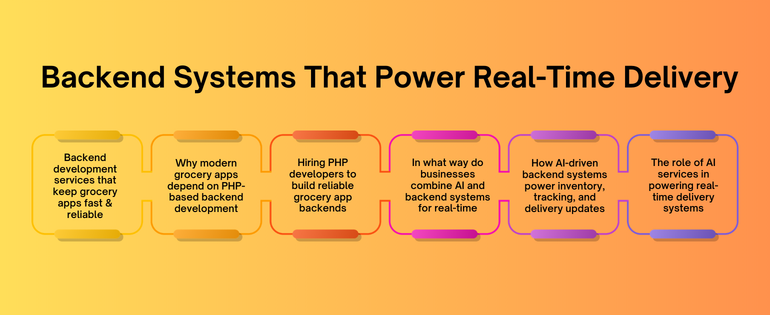
Why modern grocery apps depend on PHP-based backend development
As new technologies are popping up, PHP based backend remains one of the most reliable backend technologies for a big transaction-based platform. Most grocery app is built on PHP because of its flexibility and robustness to manage high server-side logic.
A good PHP development company can design robust backend systems that support databases, third-party APIs, payment gateways, and logistics platforms. PHP is designed for accelerated development but not at the cost of safety; this makes it a perfect fit for both start-ups and established businesses. If combined with good frameworks, PHP developed backend performs well under heavy loads, such as the festivals or the weekend rush hours.
Hiring PHP developers to build reliable grocery app backends
The design brings an on-demand feel to the app for grocery delivery, and it goes by the user’s location. Companies that onboard PHP developers who possess real-time skills in on-demand platforms tend to get a significant edge. Upvoted for position 1, but number 2 and Number 3 have been done before (Indeed, we all know how to write optimized database queries / handle parallel requests and threading, so your app does not die).
When businesses hire PHP developers, they aren’t just purchasing code — they’re buying backend logic that can scale over time. Experienced developers build solutions that support new clothing subscription models, loyalty programs, or multi-city expansion with minimum effort. “Firms, such as Developer Per Hour,” often are slammed with requests for backend expertise because what will keep apps really working as company-user bases scale is good infrastructure.
In what way do businesses combine AI and backend systems for real-time
These days, grocery apps are much more than just an ad hoc service: Intelligence has been introduced into the backend systems of these apps. This is the area where AI development services become increasingly significant. AI algorithms analyze user behavior, delivery frequencies, and demand patterns to make backend systems smarter and more reactive.
Companies combine AI with backend systems to automate decisions like which delivery partner is closest to the customer or when trucks can actually reach the customer’s doorstep. AI development solutions also assist in price optimization, product recommendations, and minimizing order cancellations. When done right, AI is invisible to the user, and it helps create efficiencies in the back-end.
How AI-driven backend systems power inventory, tracking, and delivery updates
Real-time inventory accuracy is perhaps one of the biggest challenges that a grocery app faces, and AI-powered backend software works by constantly monitoring the movement of inventory and order velocity.
These systems also facilitate delivery tracking, routes being altered according to traffic, weather, and the availability of drivers. Backend development services provided by these systems, which are enabled by AI, ensure that delivery status is as accurate as possible, promoting efficient operations management. A majority of enterprises have partnered with a PHP development company that is capable of incorporating AI development services into their system.
The role of AI services in powering real-time delivery systems
While AI services do not replace backend systems, they complement them. For example, AI services do not entirely replace fraud detection during payments, nor do they replace order surges using AI in delivery systems, ensuring timely delivery with speed, costs, and efficiency.
For developing and growing grocery businesses, integrating backend development services and AI development services can help companies scale their businesses without having their costs scale exponentially. Developer Per Hour, for instance, can help businesses develop backend systems that are not only AI-ready but will also scale as the businesses scale, considering their future requirements as a priority.

Conclusion
There are many successful grocery apps that have a backend infrastructure designed to be fast, precise, and scalable. There are many different backend architectures, which are designed using PHP to use the power of AI to provide intelligence. There are many businesses that are currently investing in backend development services and are hiring PHP developers to be at the top of the game.
With increasing assortment in the on-demand grocery space, backend solutions will continue to be the key factor that distinguishes a struggling app from a scalable one. Optimizing technology can be a daunting task.