
Mobile app development represents a significant achievement for businesses, yet initial inquiries from business stakeholders center on the project time duration required for app development. The development time required for an application depends on several factors, which include its design complexity and feature count, and the technologies used in the project. Development timeline patterns provide businesses with essential information to create budget plans, allocate resources, and establish feasible launch date projections.
This guide examines mobile app development processes together with the effect of features, integrations, and scalability requirements on project completion time.
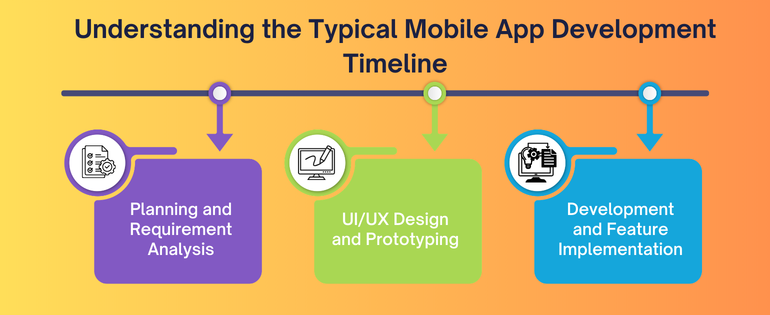
Understanding the Typical Mobile App Development Timeline
The duration of a standard mobile app development project ranges from three months to nine months. Basic apps, which provide essential functions, need approximately three months to develop, whereas extensive platforms with sophisticated integrations and intricate operational procedures demand considerable additional time to complete their development.
Mobile application development companies divide their development workflow into distinct phases, which include planning and design, development, testing, and deployment. The development process for products comprises various stages that determine both the quality of the final product and the characteristics of its performance.
The professional app development companies complete all stages of development, which enables them to deliver projects on time while meeting their technical requirements and business goals.
Planning and Requirement Analysis
The application development process starts with its first phase, which creates the foundation for the entire project. The project phase establishes the application purpose and target user groups for the system while the team identifies crucial features that will support business objectives.
The stage lasts between one week and three weeks because the work requirements determine the actual duration. The development team first evaluates its competitors before they select the required technology stack and create their development plan.
Businesses decide to hire mobile app developer teams through internal employment or through partnerships with external development organizations. The documentation created at this point establishes project requirements that prevent future project misunderstandings and work slowdowns.
UI/UX Design and Prototyping
After planning, designers start building the user interface and overall user experience of the app. This stage includes creating wireframes, visual layouts, and interactive prototypes that demonstrate how users will navigate through the application.
Designing interfaces takes two to four weeks because different interface designs have different degrees of difficulty. Users require good UI/UX design because it helps them navigate the application while providing them with a pleasant visual experience.
Mobile application development companies recognize this stage as important because prototype creation allows stakeholders to understand the final product, which reduces expenses that arise from design changes during development.
Development and Feature Implementation
The application development process begins to take form during its development stage because developers create all necessary components, which include front-end user interface and back-end system infrastructure, together with application programming interfaces and database systems to run the application.
The duration of this stage needs to be assessed according to the complete list of required features. Basic apps with limited functionality may take two to three months to complete development, whereas complex apps, which include marketplaces, fintech platforms, and social networks, require four to six months or more for their development process.
Mobile app development companies need to hire specialists who can develop applications for both iOS and Android and cross-platform environments because they want to speed up their development process. Developers who possess advanced skills create scalable software solutions that enable their applications to function without interruption while defending their systems against security risks.
Modern applications require companies to use advanced technologies because they need to create automation systems, recommendation engines, and predictive analytics tools. The development team needs to develop additional data processing components together with testing requirements, which will increase operational time because of the necessary development work to create these testing requirements.
How Advanced Features Influence Development Time
The length of time needed to develop an application depends on both its feature types and feature quantities. Basic features, such as login systems and push notifications, and simple dashboards, take less time to develop.
The building of advanced features needs extra work during the development process which requires real-time messaging systems and payment gateway and geolocation services, and advanced analytics tools. The system needs to be developed through two main components, which include external system links and the creation of backend systems that need an exact technical setup.
The growing trend of AI software development in modern businesses enables them to create personalized user experiences. Intelligent search systems. Automated decision-making processes for their applications. Although these innovations improve product value, they need extensive development work and comprehensive project planning.
A trustworthy mobile application development company will assess feature difficulty at the beginning of their project work to maintain prediction accuracy about project completion dates.
Testing and Quality Assurance
The application requires a test phase before its official release. The quality assurance team uses this stage to detect bugs and security vulnerabilities, and performance issues that might harm user experience.
The testing process conducted by developers includes multiple testing methods, which assess both system functionality and user experience and device compatibility across different operating systems. The duration of this stage lasts from two weeks to four weeks because it depends on how big the application is.
Testing costs represent a significant financial commitment for mobile application development companies because they use testing to verify that their apps will function properly for end users.
Deployment and Launch
The application is ready for launch on Google Play and Apple App Store after passing all test requirements. The deployment process requires network configuration and completion of all documentation work, and submission of the application to stores for approval.
The launch process requires between one and two weeks to complete because of the time needed for marketplace reviews. Developer Per Hour assists businesses by handling all technical submission needs and verifying that the application conforms to platform requirements.
Post-Launch Growth and Scalability
The app launch marks the start of ongoing operations for the business. The company must enhance its product through better performance, security, and greater system capacity as user numbers increase. Development after the initial launch includes the implementation of new features and system updates, and the enhancement of system architecture.
AI software development enables organizations to combine advanced analytics tools with automation systems and AI-powered chatbots. The application updates improve user engagement while maintaining the application’s competitive status in the market.
Long-term business growth requires organizations to work with development partners such as Developer Per Hour, who will support their app maintenance, new feature development, and platform upgrades needed to meet evolving user requirements.

Conclusion
The timeline for mobile app development depends on multiple factors, including the number of features, the complexity of integrations, and scalability requirements. The development period for basic applications requires three months, whereas the creation of complex applications with advanced features and artificial intelligence functions takes more time.
The hiring of mobile app developer teams requires businesses to select proper development strategies while working with experienced mobile application development companies to achieve better project results. The understanding of development stages enables businesses to implement more effective project planning while developing mobile applications that generate sustainable value in the competitive digital market.