Fintech applications work at the junction of money, data, and trust. Be it digital payments, lending platforms, or investment apps, users expect their financial data to be safeguarded at all levels. Even a single mistake in security can result in regulatory penalties, financial losses, and irreversible damage to the brand reputation. That is the reason why secure fintech app development is not about adding features; rather, it is an act of building a multi-layered security foundation from day one.
Modern fintech platforms combine backend safeguards, intelligent monitoring, and user-level protections. Today, leading mobile app development companies with a focus on fintech design security, not as an afterthought, but rather as an intrinsic core architecture element. Let’s explore the eight essential security layers that power secure, compliant, and future-ready fintech applications.
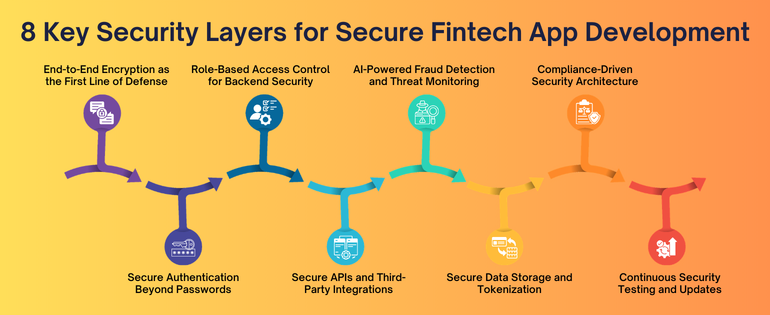
1. End-to-End Encryption as the First Line of Defense
Encryption lies at the heart of fintech security. Accordingly, it ensures that critical data, like details of accounts, records of transactions, and personal data, remain unreadable to unauthorized parties. Strong encryption secures data both in transit and at rest to minimize the associated risks of interception or leakage.
A trustworthy mobile application development company uses advanced encryption standards throughout APIs, databases, and cloud storage. For fintech applications running on both Android and iOS, encryption strategies should be the same irrespective of the device or operating system.
2. Secure Authentication Beyond Passwords
In addition, passwords for fintech sites and platforms would no longer be enough. Hence, multi-factor authentication or MFA, which consists of something the user knows, something the user has, and something the user is, has emerged as an industry requirement.
The majority of Android app development agency teams are now implementing biometric authentication, such as fingerprint and face recognition, whereas iOS uses face recognition technology along with Touch ID by virtue of native development frameworks. This evolution in security has shown to minimize unauthorized access, although valid login credentials are compromised.
3. Role-Based Access Control for Backend Security
Not every user or admin needs to be privy to the same information. With Role-Based Access Control (RBAC), roles are assigned only on the basis of responsibilities. Thus, any potential threat or security breach is kept to a minimum.
Fintech applications developed using highly scalable backend infrastructure can provide fine-grained permission settings for admins, finance personnel, or support staff. Seasoned ios app development services providers can help implement RBAC models while meeting compliance needs.
4. Secure APIs and Third-Party Integrations
Fintech apps also rely on third-party services for payment-related activities like payment itself, identity verification, and analytics. Third-party service integration is always a point of security risk. For secure APIs with authenticating tokens, security is of utmost importance.
This is because a mobile application development team with experience in dealing with fintech-related issues will ensure that APIs are constantly being updated. This is especially important with a fintech ecosystem, as it is constantly evolving with the incorporation of additional services.
5. AI-Powered Fraud Detection and Threat Monitoring
Traditional rule-based systems of fraud detection are now obsolete. It is here that AI development services make a huge difference. AI systems scrutinize and analyze transactions, machine learning-based patterns, and usage anomalies in real-time to identify possible abuses.
Fintech apps, for instance, with AI-based security, can protect users against online fraud attempts. Many businesses are working with companies like Developer Per Hour to offer AI development services, which improve the security of their apps without reducing their performance and usability.
6. Secure Data Storage and Tokenization
For storing sensitive financial data, mere encryption is not sufficient. Tokenization is a mechanism where vital identifiable data, like credit cards, is replaced with non-sensitive tokens that have no useful or exploitable value outside the system.
Leading Android application development team companies usually use tokenization along with an encrypted database and a storage environment, as even if a breach happens, the attacker will not have access to any financial information.
7. Compliance-Driven Security Architecture
Fintech applications should follow regulations like PCI-DSS, GDPR, and financial guidelines based on the region. Compliance is not just about keeping documentation; rather, it also impacts how the design and implementation of security systems take place.
A mobile app development company with a background in fintech integrates compliance checks into the development process. Regular audits, logging mechanisms, and data retention policies ensure that security complies with ever-changing regulatory standards in many markets.
8. Continuous Security Testing and Updates
Furthermore, security is not an implementation. This means that security threats are constantly evolving, hence the need for constant testing and updating of the application. This is where pen tests, vulnerability tests, and protective monitoring come in.
Teams that specialize in iOS app development services and Android app solutions may incorporate features like continuous security tests as part of the long-term maintenance. Developer Per Hour, for example, emphasizes the importance of timely security updates as a way of ensuring the apps used in fintech remain robust enough as the state of technology changes.
Why Layered Security Matters in Fintech App Development?
Furthermore, no single security solution protects the fintech app in isolation. True security comes from multiple defenses combined in concert seamlessly. Encryption protects the data, multi-factor authentication protects access, artificial intelligence protects against threats, and compliance builds trust at scale.
Therefore, fintech companies can create applications that their clients trust with their financial lives with the help of an experienced mobile app development company, as well as specialized AI development services. Secure fintech app development is all about finding a balance.

Final Thoughts
From encryption to MFA and AI-driven fraud detection systems, the development of secure fintech apps is heavily reliant on an effectively coordinated security framework. Moreover, every layer of this framework effectively builds on the other to develop a strong security platform that can effectively tackle real-world threats. While providing security guarantees to businesses, investing in layered security tools early enough can significantly enable them to remain competitive in the modern trust-based fintech arena.