
Choosing the right technological stack is a very pivotal point which determines a startup’s fate when they decide to develop a mobile app. A tech stack, right or wrong, will decide the startup company in essence, i.e., how fast the product will be in the market, what will be the user experience, scalability, security, and even the upkeep of the product in the long-term period. The only problem is that there exist hundreds of frameworks, languages, and tools, with each one of them claiming to be the best.
If you are planning to work with a mobile app development agency USA, want to hire mobile app developers, or are considering assembling an in-house team, knowing how the tech stack affects your app will allow you to be more certain in your decision.
This handbook reveals the nerve of the matter concerning what a technology stack is, how to pick the right one, and which choices work best for startups that want to grow fast and cheaply.
What Is a Tech Stack in Mobile App Development?
A tech stack is the combination of programming languages, frameworks, tools, and software used to build an app. It includes:
Frontend (Client-side)
The part users interact with — UI, animations, touch gestures, screen transitions.
Backend (Server-side)
APIs, databases, security, cloud storage, authentication, and logic that powers the app.
Development Tools
Frameworks, libraries, testing tools, CI/CD pipelines, and DevOps tools.
The ideal tech stack should help your developers build faster, maintain easily, and scale without friction.
Why Tech Stack Matters for Startups
Startups are under a lot of pressure to do more with less and at an incredibly fast pace. If a startup has a poor tech stack, it will result in:
- Development that takes longer than expected
- Maintenance costs that are more than anticipated
- Performance that is below par
- Difficulty in adding new features
- Security vulnerabilities
- Frequent crashes or bugs
That’s why many founders consult a mobile app development agency USA or hire dedicated mobile app developers early in the planning phase to avoid costly mistakes later.
Key Factors to Consider When Choosing Your Tech Stack
1. Project Type and Complexity
Different applications require different technologies. For instance:
- A simple booking app might be built with React Native + Firebase only
- A fintech or banking app can necessitate Swift/Kotlin + advanced security frameworks
- A real-time delivery or tracking app would have to be a robust backend + geolocation tools
Once you have a mobile app developer team on board, it is your responsibility to define the:
- Purpose of the app
- Target users
- Essential features
- Complexity level
- Future goals
This ensures a tech stack that fits both present and long-term needs.
2. Budget and Development Speed
Startups often need to launch fast without overspending.
Native Development (Swift for iOS, Kotlin for Android)
Pros: Best performance, maximum control, strong security
Cons: Costly, development is slower (two apps needed)
Cross-Platform (Flutter, React Native)
Pros: Faster development, lower cost, single codebase
Cons: A little limited in advanced native features
If either the budget or the speed matters the most, then a great number of founders decide to hire dedicated mobile app developers who are proficient in cross-platform frameworks.
3. Scalability Requirements
The app that you have at the moment might be small, but it is supposed to be able to grow later on.
Ask these questions:
- Will the app handle thousands of users soon?
- Do you plan to expand features regularly?
- Will the app have to integrate the new APIs later on?
A reputable mobile app development agency USA would suggest the use of scalable technologies such as:
- Node.js — Excellent in handling heavy traffic
- Firebase — Simple to scale for MVPs
- AWS or Google Cloud — For scaling at an enterprise level in the long run
- Flutter — UI and features that are very scalable
Choice of the wrong tech stack could hinder your growth later on.
4. Security Needs
In the case of fintech, healthcare, or e-commerce apps, security is the most important thing that cannot be compromised.
Developers may implement:
- AES-256 encryption
- OAuth & JWT
- SSL pinning
- Secure backend frameworks
- Encrypted databases
Before you hire mobile app developer teams, confirm they understand how to secure sensitive information.
5. Maintenance & Long-Term Updates
Apps evolve constantly—new OS updates, new features, new screens, and new devices.
Frameworks with long-term community support (like Flutter, React Native, Kotlin, Swift) are safer.
Cheap or outdated technologies may:
- Break quickly
- Be expensive to maintain
- Have no developer support
- Slow down future updates
That’s why most startups trust developers who specialize in modern, well-supported stacks.
Most Popular Tech Stacks for Startups in 2025
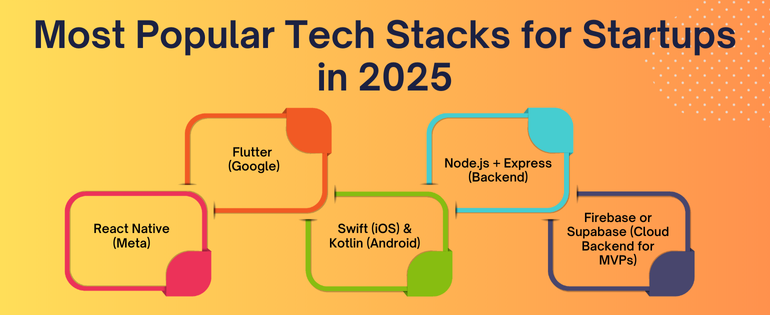
1. Flutter (Google)
What makes Flutter the best option for startups is how quickly they can build cross-platform applications.
Pros:
- One codebase
- Rapid development
- Great UI
- Almost like native performance
Great choice if you want to hire dedicated mobile app developers who can deliver an MVP quickly.
2. React Native (Meta)
One of the most widely used cross-platform frameworks.
Pros:
- Big community
- Component reusability
- Good user experience with the app interface
- Development is faster
Ideal for apps with social features, dashboards, or real-time updates.
3. Swift (iOS) & Kotlin (Android)
The best for top-performance apps.
Pros:
- Maximum stability
- Best user experience
- Great for complicated apps
- Needed for hardware-level features
If it is a mobile app development agency USA that you are cooperating with, then most probably they will suggest native development for their enterprise clients.
4. Node.js + Express (Backend)
The most used backend for mobile apps is Node.js + Express.
Pros:
- Extremely scalable
- High speed
- Good for real-time systems
- Compatible with every frontend
What makes a perfect combination for delivery apps, social apps, financial dashboards, and other similar apps is Node.js + Express.
5. Firebase or Supabase (Cloud Backend for MVPs)
The best option for a startup is to have a fast backend setup with the likes of Firebase or Supabase.
Pros:
- Real-time database
- Authentication out of the box
- Cloud hosting made simple
- Deployment made easy
Startups frequently opt for Firebase so that they are able to save time and put less money into backend development.
Whether You Outsource or Hire, Expertise Matters
Whether You Outsource or Hire, Expertise Matters
You have the liberty to try out different tech stacks, but if you make a mistake in the development process, it will cost you dearly. For this reason, a large number of founders either:
- Hire mobile app developers with a track record of success, or
- Work with a mobile app development agency USA for technical support
Both ensure you get a stack that:
- Aligns with your vision
- Supports scaling
- Ensures good speed
- Gives better security
- Improves security
- Reduces long-term costs
A strategic technical foundation increases your chances of building a high-quality, revenue-ready mobile app.

Final Thoughts: The Best Tech Stack Is the One That Supports Your Vision
There’s no universal “perfect” tech stack. The best one balances your goals, budget, features, timeline, and scalability requirements. Whether you choose Flutter, React Native, Swift, or Kotlin, what truly matters is having skilled engineering talent behind the project.
In case you hire dedicated mobile app developers or get assistance from a proficient mobile app development agency USA like Developer Per Hour, you will likely end up selecting a stack that would ensure your startup’s long-term success.