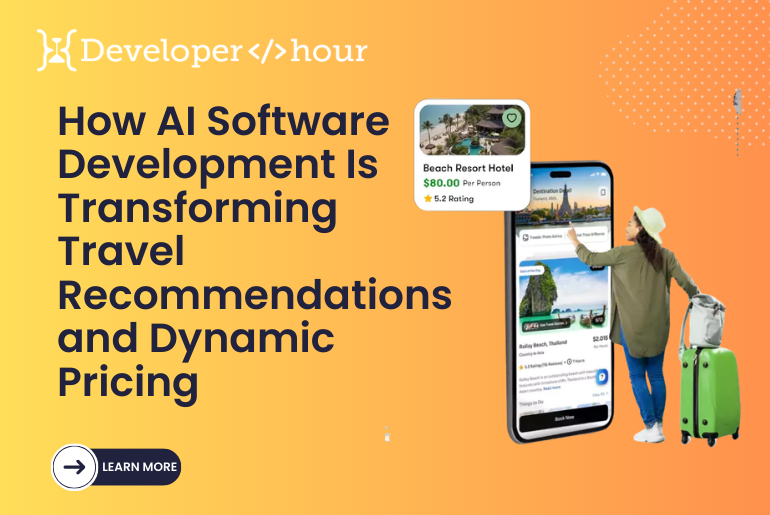
The travel industry has always depended on three primary factors, which are timing, personalized services, and competitively priced offerings. The current digital-first environment requires businesses to implement pricing systems and provide tailored services instead of using their existing standard pricing and common recommendation systems. Travelers require personalized travel suggestions, they need to see fare changes in real time, and they want to receive immediate assistance on multiple platforms. AI software development operates as the core technology that transforms travel business operations.
Artificial intelligence enables flight aggregators, hotel booking platforms, and tour marketplaces to deliver advanced recommendation systems that generate dynamic pricing models that modify their rates according to market demands, seasonal patterns, and buyer habits. Modern AI development companies are helping travel brands build systems that don’t just respond to users—but anticipate their needs.
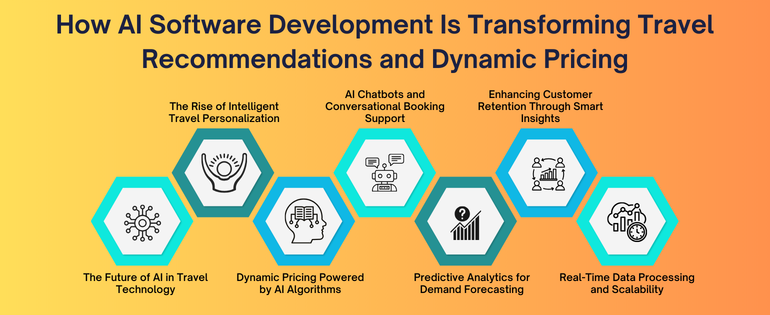
The Rise of Intelligent Travel Personalization
Recommendation systems rely on three basic filters, which include filters that detect a user’s location, their budget, and their product preferences. AI software development enables travel platforms to implement hyper-personalized suggestions through its ability to analyze user browsing history and booking patterns, seasonal patterns, and current search activity.
If a traveler regularly books beach vacations in the wintertime, AI algorithms can start recommending actual beach trips for the next summer season. AI models can also factor in preferences such as airline choices, hotel categories, and price sensitivity. Leading AI development companies build predictive engines that refine recommendations continuously, learning from each user interaction.
The advanced personalized system provides users with better experiences, which leads to higher conversion rates and stronger customer loyalty. The travel platforms that use advanced ai development services enable users to have tailored experiences instead of facing a situation where they see multiple options.
Dynamic Pricing Powered by AI Algorithms
The travel industry has always seen price changes that result from variations in consumer demand and available services. The current market environment requires businesses to use more advanced systems than existing manual control methods and fixed guideline systems. The development of artificial intelligence software products enables real-time pricing systems to modify prices for tickets and hotel accommodations within a few seconds.
Dynamic pricing models examine various factors, which include competitor prices, booking rates, seasonal demand patterns, weather conditions, and local happenings. The system automatically modifies pricing when there is an increase in demand. The system activates special pricing discounts when there is a decline in booking activity. The system enables businesses to generate revenue through automated processes that require no human monitoring.
Companies that develop artificial intelligence solutions now create tailored pricing systems that help businesses achieve their revenue objectives. The travel industry uses advanced AI development services to achieve optimal pricing strategies, which drive business success.
AI Chatbots and Conversational Booking Support
The travel industry relies on artificial intelligence to improve customer support services. Travelers need instant responses about flight cancellations, schedule changes, baggage requirements, and visa application processes. Travel companies can deliver round-the-clock customer support through AI chatbot development services, which help them maintain their current operational expenses.
Current AI chatbots provide more capabilities than basic prewritten answer systems. The systems use natural language processing to comprehend user intent while delivering contextual answers and enabling users to book services through the chat window. An effective AI chatbot development service can integrate seamlessly with booking systems, payment gateways, and CRM platforms.
Businesses that collaborate with specialists like Developer Per Hour create chatbot systems that help customers and provide them with customized travel package suggestions that operate in real time. The combination of service delivery together with upselling activities generates results that companies can use to track their financial performance.
Predictive Analytics for Demand Forecasting
Travel demand exhibits unpredictable behavior because economic conditions, geopolitical events, and public attitudes all affect travel patterns. AI software development enables businesses to use predictive analytics tools, which provide superior accuracy for forecasting booking trends than conventional forecasting techniques.
AI systems utilize historical booking data and external factors to predict peak travel times and track popular routes, and determine occupancy levels. This enables travel companies to execute marketing strategies while distributing resources and modifying their pricing methods.
Travel brands can use complete AI development services to solve their revenue loss problems, which occur because of selling prices that are too low and their failure to capture customer demand. Today, many AI development companies create machine learning models that directly serve the hospitality and travel industry.
Enhancing Customer Retention Through Smart Insights
Travel companies face high customer acquisition expenses, which make it necessary to develop effective methods for customer retention. AI-powered recommendation systems assist platforms in bringing back users through matching them with suitable offers, which depend on their previous search history and inactive booking selections.
AI uses flight browsing data to detect when users who search for Paris flights fail to book their tickets. AI software development frameworks enable intelligent engagement methods through their effective AI system development execution.
Companies like Developer Per Hour support travel businesses in building scalable AI infrastructures that integrate marketing automation with recommendation engines. The result is a seamless user journey that feels intuitive rather than intrusive.
Real-Time Data Processing and Scalability
Travel platforms face their biggest technical challenge when they need to process large amounts of data throughout all their operational hours. AI software development requires cloud-based processing, which uses scalable system designs to enable instant analysis of millions of data points.
Dynamic pricing engines, recommendation systems, and chatbot interactions all depend on continuous data updates. Reputable AI development companies focus on building resilient systems that can handle changing user demands while maintaining their operational capabilities.
Travel companies can use specialized AI development services to maintain their system responsiveness during their busiest times and special marketing events.
The Future of AI in Travel Technology
The predictive capabilities of travel platforms will increase through future AI developments. The market already displays three emerging trends, which include voice-based booking assistants’ AI-powered itinerary planning and automated dispute resolution.
AI chatbot development service providers will need to expand their capabilities to provide multilingual support and sentiment analysis, and personalized travel concierge services. AI development companies will develop better model transparency methods while they execute ethical AI practices for dynamic pricing systems to maintain fairness.
Travel brands that invest in robust AI infrastructure today will be better positioned to compete in an increasingly data-driven marketplace.

Conclusion
AI software development has become an essential part of contemporary travel operations because it is the main system powering current booking systems. The travel industry uses AI to develop customer attraction strategies that drive customer conversion and customer retention efforts through its intelligent recommendation system, dynamic pricing model, and conversational support system.
The travel industry can achieve improved operational efficiency and business success through partnerships with established AI development firms and the use of their complete AI development solutions. The travel industry is undergoing a transformation driven by AI, which provides personalized recommendations through predictive analytics and advanced AI chatbot development.