Blockchain has evolved from being a technology that only a few people knew about to a major innovation that is helping to bring transparency, automation, and security to different industries like finance, supply chain, healthcare, and gaming. However, despite its increasing use, a lot of businesses are still confused about how blockchain app development is carried out.
Whether you are a startup founder with a new dApp idea or a corporate executive wanting to digitize your operations, knowing the development process will enable you to work more efficiently with blockchain developers and choose the right blockchain development companies.
This detailed manual of the different stages of the workflow, from the very first concept to the final tuning after the release, helps you to be aware of each step.
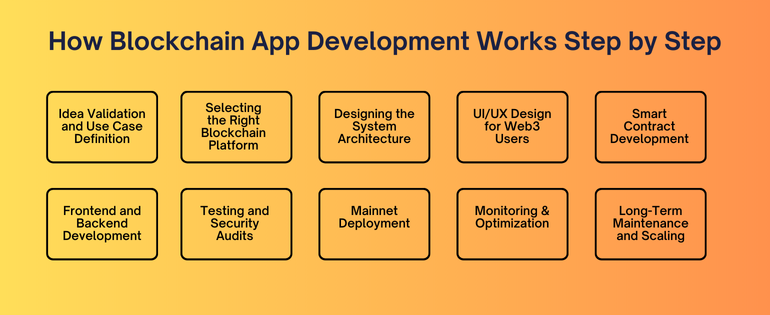
Step 1: Idea Validation and Use Case Definition
Every triumphant blockchain app starts with a definite goal. Prior to getting involved with technical aspects, you must analyze:
- Which problem from the real world will your app solve?
- Is decentralization really giving an additional value?
- Who will be the app users and for what reason?
- What information is necessary to be saved on-chain rather than off-chain?
The blockchain development leaders and teams, like Developer Per Hour, initiate their projects with feasibility studies to verify if blockchain is the right solution rather than just a trendy word. A well-conducted use-case analysis is your assurance that you are creating something viable, capable of growing, and ready for the market.
Step 2: Selecting the Right Blockchain Platform
The various blockchain networks bring forth their own unique benefits. Among the most widely used are:
- Ethereum
- Polygon
- Solana
- Binance Smart Chain
- Hyperledger Fabric
- Avalanche
Platforms differ in speed, price, supported smart contract languages, and the degree of development of their respective ecosystems. Experienced blockchain developers guide you through these technical decisions by analyzing:
- Required transaction speeds
- Deployment costs
- Smart contract complexity
- Security needs
- Regulatory requirements
Choosing the right chain early prevents performance bottlenecks later.
Step 3: Designing the System Architecture
A blockchain app is comprised of both on-chain and off-chain elements. Architectural planning involves designing:
- Smart contract structure
- Data flow and storage
- API integrations
- Wallet connections
- Authentication logic
- Node setup
- Frontend and backend systems
Expert blockchain development companies create in-depth technical specifications, wireframes, workflows, and architecture diagrams to align all the components of the application seamlessly.
Such a plan forms the basis of reliable long-term scalability.
Step 4: UI/UX Design for Web3 Users
Even the strongest backend fails without a user-friendly interface. dApp UI/UX design must accommodate:
- Wallet integration
- On-chain transaction prompts
- Real-time blockchain status updates
- Token balances
- Security notifications
In contrast to Web2 apps, blockchain apps need more transparency for actions such as signing a transaction or viewing the details of a contract.
Developer Per Hour is one of the teams that help build such Web3-friendly interfaces that are simple, clean, and intuitive—even for a person new to blockchain.
Step 5: Smart Contract Development
The engine of any blockchain application is smart contracts. They handle:
- Transactions
- Rules and logic
- Asset creation (tokens, NFTs)
- Access control
- Automation
PM blockchain developers use different programming languages like Solidity, Rust, or Go for writing smart contracts, depending on the network selected. This step involves:
- Coding contract functions
- Defining data structures
- Implementing business logic
- The creation of token standards (ERC-20, ERC-721, etc.)
- Ensuring secure logic flow
Since smart contracts can’t be changed once deployed, they are subjected to intensive review and testing before release.
Step 6: Frontend and Backend Development
Once contracts are ready, development moves into building the actual application layers.
Frontend Development
- User dashboards
- Transaction screens
- Wallet connection modules
- Token display components
Backend Development
- Off-chain data processing
- Database management
- Authentication services
- API development
- Integration with blockchain nodes
The frontend uses Web3 libraries such as Web3.js, Ethers.js, or SDKs tailored for specific networks to connect with the blockchain.
This is the stage at which the blockchain app development gets fully shaped and gets ready for users.
Step 7: Testing and Security Audits
Testing is very much needed in blockchain applications, as security weaknesses can lead to the loss of money that can’t be reversed.
Smart Contract Testing
- Unit tests
- Functional and regression tests
- Gas usage optimization
- Security and vulnerability scans
- Independent audits
Application Testing
- UI testing
- Compatibility checks
- Performance testing
- Wallet integration tests
- Cross-device validation
Top blockchain development services ensure that every module works flawlessly before deployment.
Step 8: Mainnet Deployment
Once the app is fully tested, the team prepares for launch by deploying:
- Smart contracts to the mainnet
- Backend systems to servers or the cloud
- Frontend to hosting platforms (IPFS, AWS, etc.)
- Node infrastructure (if required)
The deployment will require utmost accuracy since the smart contracts on the blockchain will become forever visible and accessible post-launch.
Step 9: Monitoring & Optimization
Then, when the application is live, constant supervision is a must in order to guarantee that everything is working properly. Developers track:
- Gas fees and transaction speed
- Network congestion
- Contract performance
- User behavior
- Node health
This stage also involves optimizing UI flows, improving data handling, and resolving issues as adoption grows.
Step 10: Long-Term Maintenance and Scaling
Blockchain technology evolves fast. To stay relevant, apps require:
- Contract upgrades
- Additional features
- Multi-chain expansion
- Improved wallet integrations
- Security patching
- Performance enhancements
Many companies keep blockchain developers on their payroll for an extended period of time to maintain the security of their dApps and make them ready for the future.

Final Thoughts: It Takes Expert Knowledge to Go Through the Whole Chain of Events from Idea to Deployment
Blockchain programming is a complicated operation that demands careful consideration of the plan, high-standard security measures, and profound technical knowledge. When you work with an experienced blockchain development company or employ a qualified professional, you are making sure that your app is safe, can be expanded, and is designed to win in a competitive Web3 environment.
Knowing these steps provides you with the understanding and assurance to execute your idea and thus, making your journey of developing a blockchain app from the initial idea to the final release, trouble-free.