One of the very first decisions that a startup needs to make is whether or not to hire the right talent technically, which is turning out to be one of the biggest choices. An excellent developer may be the ultimate element that either fails or leads you to success in your digital journey, irrespective of whether you are constructing an MVP, upgrading your product, or staging a huge expansion.
This guide breaks down everything you need to know: required skills, different models, vetting process, red flags, and how the selection of the right mobile app development agency USA can simply be your product scaling way.
Why Hiring the Right Developer Matters for Startup Growth?
An application is more than just a digital product — it is the foundation of your brand experience these days. The app affects your revenue, customer loyalty, business efficiency, and scaling possibilities.
If the hired mobile app developer is not only skilled in technology but also has a good understanding of the business side of things, then the following are your gains:
- Speedier go-to-market campaign
- Lower long-term software development expenditure
- Less technical debt
- Increased user retention
- An app that grows with your customer base
Startups require developers who are capable of thinking long-term and not just writing short-term features.
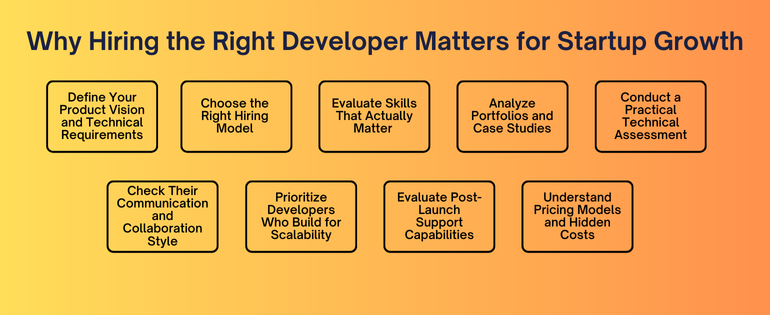
Step 1: Define Your Product Vision and Technical Requirements
You should prepare an outline of your expectations from an app even before you start looking. Proper documentation makes it possible to find a developer whose vision matches yours.
Clarify the basics:
- What problem does your app solve?
- What features are essential for the MVP?
- Do you need native, hybrid, or cross-platform development?
- What tech stack do you prefer (React Native, Flutter, Swift, Kotlin, etc.)?
Most of the time, startups overlook this phase — as a result of which they face mismatched expectations, budget overruns, and delays. A clearly laid-out plan allows you to decide whether freelancers, an in-house developer, or a mobile app development agency USA would be the best solution for you.
Step 2: Choose the Right Hiring Model
Usually, startups decide on one out of three types of models. Making a correct decision depends on how fast you want things to go, how much you are willing to spend, and what you are good at internally.
1. In-House Developers
The best option for startups that foresee a long-term product development with continuous upgrades.
Pros: Communication in real-time; more ownership
Cons: Expensive; hiring process is slow; onboarding takes time
2. Freelancers
Good for one-time, small, or trial projects.
Pros: Budget-friendly
Cons: Limited accountability; reliability issues
3. Hiring Through an Agency
Such a decision is typical for startups that are mainly focused on speed, expertise, and accountability.
Among the benefits that a cooperation with a famous and reliable mobile app development agency USA brings to your company are the following:
- An experienced team
- Workflows that have already been set up for development
- The process of quality assurance
- The talent pool can be increased whenever needed
- Shortened delivery timelines
If you are willing to hire the best mobile app developers for a few hours a week but you do not want to take the full-time staffing overhead, then this solution will suit you the most. That is the reason why so many startups choose to work with developers like Developer Per Hour — thus they are able to get specialized talent with minimum operational friction.
Step 3: Evaluate Skills That Actually Matter
Many startups fall into the trap of choosing their hires only based on technical skills. That is only half of the picture.
Technical Skills to Look For:
- Experience with your preferred tech stack
- Knowledge of API and backend integration
- Understanding of Database/Cloud
- Awareness of UI/UX
- Proficiency in Testing and debugging
Non-Technical Skills That Define Success
- Problem-solving mindset
- Communication clarity
- Ability to work in agile sprints
- Scalability-first thinking
- Understanding of product roadmaps
A developer who understands product growth is far more valuable than one who just writes good code.
Step 4: Analyze Portfolios and Case Studies
The past work of a developer tells you way more than a resume does. Look for. App store links to live applications
- User interface quality
- Performance and loading speed
- The complexity of features
- Industry relevance
If you hire a mobile app development agency USA, then surely you must be looking forward to the case studies. They show how the team solved the real-world problems and scaled the apps over time.
Step 5: Conduct a Practical Technical Assessment
Developers should be tested with a small real-world assignment rather than theoretical questions.
What you can evaluate through this are:
- Coding quality
- Architecture planning
- Problem-solving approach
- Speed and efficiency
- Attention to detail
This step is very important if you are planning to hire mobile app developers for long-term cooperation.
Step 6: Check Their Communication and Collaboration Style
A developer who is brilliant but can’t communicate is a liability. Misaligned expectations can slow down your entire roadmap.
Evaluate how well they:
- Understand your product
- Ask relevant questions
- Report progress
- Adapt to feedback
- Collaborate with designers, PMs, and other developers
Good communication = fewer revisions, faster launches, and lower costs.
Step 7: Prioritize Developers Who Build for Scalability
When your startup is larger, your app must be able to handle more users, features, and integrations. This is the point where experience really counts. Talk with candidates about:
- Dealing with a higher number of users
- App performance optimization
- Creating scalable architecture
- Cloud services (AWS, GCP, Azure)
- CI/CD pipelines implementation
Regardless of whether you hire a mobile app developer directly or through an agency, make sure that they are thinking beyond just the MVP.
Step 8: Evaluate Post-Launch Support Capabilities
The launch of your app is not its end — it’s the beginning. Developers or partners that you can rely on and who also have support services will offer you:
- Bug fixing
- Feature enhancements
- OS updates
- Performance optimization
The best partners, like Developer Per Hour, for instance, are known for their well-organized support systems, which enable startups to smoothly scale after launch.
Step 9: Understand Pricing Models and Hidden Costs
Startups quite often have a hard time with budget planning because costs related to app development may differ a lot.
- Where can we compare pricing?
- Based on per-hour rates
- Monthly dedicated developer cost
- Project-based packages
- Maintenance fees
- Third-party API/tool costs
In case you are planning on hiring dedicated mobile app developers, it is better to clarify everything in advance so that there will be no unwanted surprises.

Final Thoughts: Build a Team That Grows With You
Choosing the right talent is not a matter of finding the cheapest and fastest option — rather, it is about selecting a partner who is aligned with your long-term vision.
You have invested in the following when hiring a mobile app developer or collaborating with a trusted mobile app development agency USA:
- The foundation of a robust product
- Quicker execution coming scalability
- Greater competitive advantage
If you follow this hiring blueprint, not only will you hire better — you will also build better.